It’s a simple situation most of us have encountered at some point—sitting on a crowded bus or train when someone boards who appears to need a seat more than we do. On the surface, it seems like a minor, almost automatic decision. Yet these small, ordinary moments often reveal something meaningful about our character, empathy, and awareness of others. Whether we respond immediately or hesitate, our reaction reflects how we interpret responsibility in shared spaces.
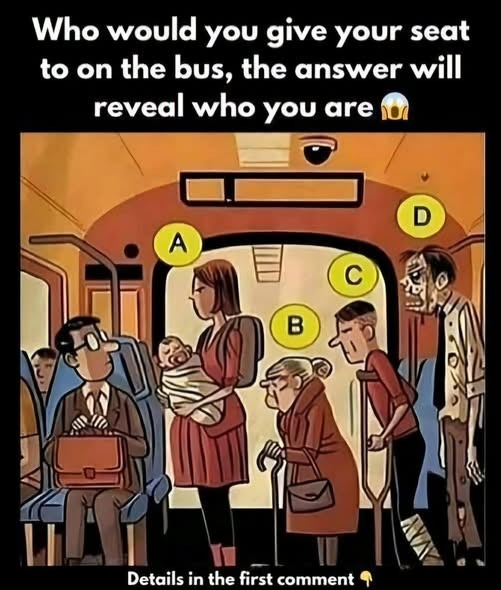
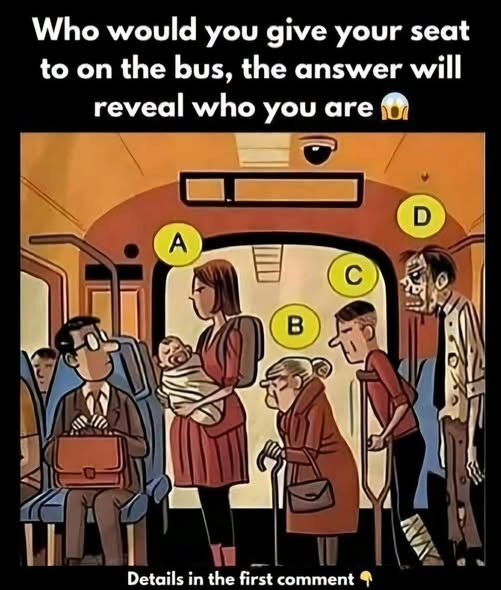
Imagine the scene more clearly. The bus is full, the air slightly heavy, conversations low and scattered. At the next stop, several passengers step on. Among them is a mother holding a sleeping baby. Her arms are tense from the weight, and she shifts carefully to avoid waking the child. An elderly woman follows, leaning on a cane, her movements slow and deliberate. A man nearby struggles to maintain his balance as the bus lurches forward, gripping the overhead rail tightly. Another passenger appears pale and fatigued, perhaps fighting illness or dizziness. None of them demand attention. None ask directly for help. Yet each presence quietly raises the same unspoken question: will someone notice?
What makes this scenario powerful is that there isn’t always a single “correct” answer. Compassion isn’t a competition. Different people may respond to different cues. Some instinctively prioritize age, believing elders deserve immediate accommodation. Others react strongly to the vulnerability of a parent carrying a child. Some are particularly sensitive to signs of physical instability or illness. These responses are shaped by upbringing, cultural norms, personal experiences, and emotional intelligence.
Psychologists often describe such moments as tests of situational empathy. Empathy is not only about feeling concern; it is about translating that feeling into action. In crowded public settings, there’s also the “bystander effect,” where individuals hesitate because they assume someone else will step in. When one person chooses to stand, however, it often breaks that hesitation and encourages others to act kindly in their own ways.
What’s striking is how these quiet choices shape the atmosphere of a community. Public transportation is one of the few places where people from vastly different backgrounds share the same physical space. It becomes a small reflection of society itself. When people act with courtesy and attentiveness, that space feels safer and more humane. When everyone looks away, avoiding eye contact to escape responsibility, the environment can feel colder and more disconnected.
These everyday moral crossroads rarely bring recognition. No one applauds when you offer a seat. There is no announcement acknowledging the gesture. Yet these subtle acts accumulate. They influence how children observe adult behavior. They affect how strangers perceive one another. They build trust in small, almost invisible increments.
Ultimately, the scenario is less about who “deserves” the seat most and more about awareness. It challenges us to look up from our phones, to observe, and to consider someone else’s comfort alongside our own. Empathy is not practiced in dramatic, headline-making moments. It is practiced in ordinary, passing situations—on buses, in grocery lines, in waiting rooms.
And perhaps that’s the deeper lesson: the kind of society we hope to live in is shaped quietly by these small, everyday decisions.