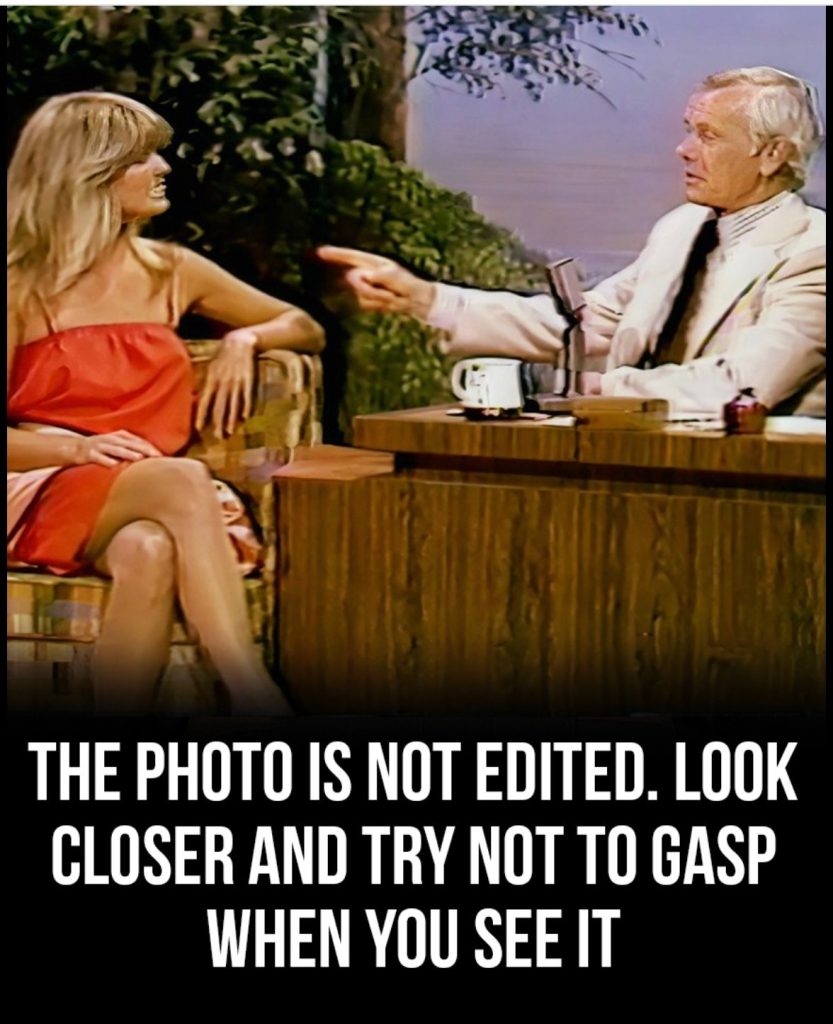
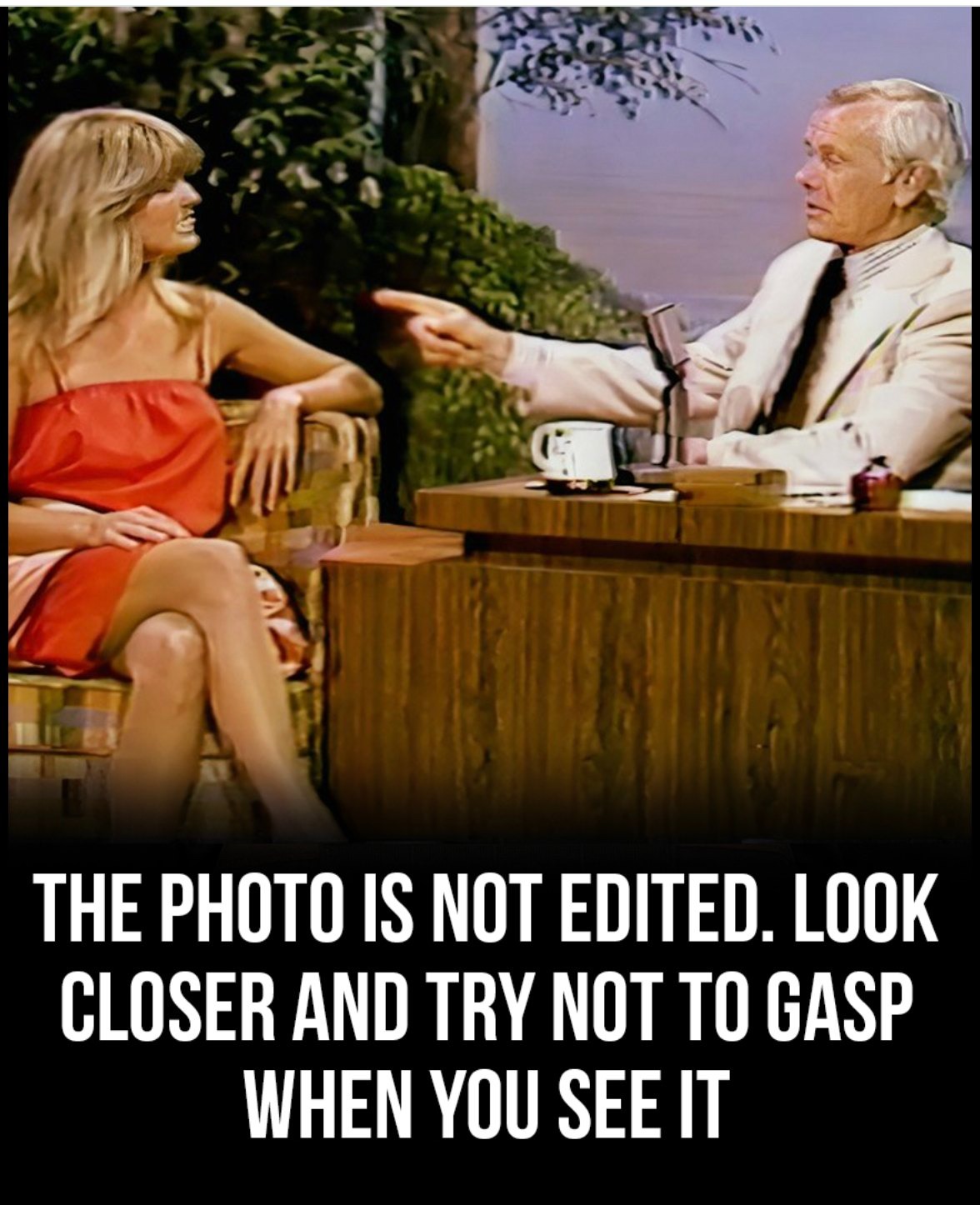
What began as a routine late-night television interview quickly transformed into a curious moment that had audiences replaying the clip again and again. The setting was completely ordinary: warm studio lighting, a polished desk, two comfortable chairs, and a relaxed conversation between host and guest. There were no dramatic announcements, no awkward exchanges, no unexpected interruptions. On the surface, it looked like just another standard talk show segment.
Yet something subtle caught viewers off guard.
As the camera lingered on a particular angle, observant audience members began noticing a small but puzzling visual inconsistency. It wasn’t flashy or immediately obvious. In fact, many people didn’t see it until someone pointed it out. But once noticed, it became impossible to ignore. From that specific perspective, the alignment of the guest’s posture, the shape of the chair, and the placement of the background created an illusion that distorted depth and proportion.
For a split second, it appeared as though part of the image didn’t belong — almost as if the guest were floating, oddly positioned, or partially disconnected from the set. The brain struggled to process what the eyes were seeing. It looked manipulated, like a poorly edited frame or a digital glitch. But there was no editing trick involved. The moment was entirely real.
What happened was a perfect example of how easily human perception can be fooled.
Our brains constantly interpret visual information by relying on depth cues such as shadows, spacing, and relative size. When those cues align in unexpected ways — especially under bright studio lights that flatten shadows — the result can be confusing. Television studios are often designed with layered backdrops and compact layouts to create the illusion of spaciousness. Furniture is carefully arranged to frame the shot attractively on camera, not necessarily to match natural depth perception from every angle.
In this case, the combination of tight staging, a fixed camera position, and the guest’s body language produced an accidental optical illusion. Because viewers were seeing the scene through a two-dimensional screen, the loss of certain depth signals made the image appear distorted. In motion, the illusion was brief and easy to miss. But when frozen into a still frame and shared online, it took on a life of its own.
Social media amplified the curiosity. Screenshots circulated, accompanied by captions asking, “What’s wrong with this picture?” People debated whether it was a green screen error, a camera malfunction, or clever trick photography. Some insisted it had to be digitally altered. Others pointed out that similar illusions have occurred in photography for decades, long before modern editing tools existed.
Ultimately, the explanation was simple: perspective.
When angles, posture, and background elements align in just the right way, they can override our expectations of space and proportion. The illusion felt impossible only because our brains expect visual consistency. When that expectation is disrupted, even slightly, the result feels uncanny.
Moments like this serve as reminders of how powerful context can be. A single frame can tell a misleading story, while the full video reveals nothing unusual at all. It highlights how perception is shaped not just by what is present, but by how it is presented.
In the end, there was no hidden secret behind the talk show moment — just geometry, coincidence, and the fascinating way our minds try to make sense of the world.