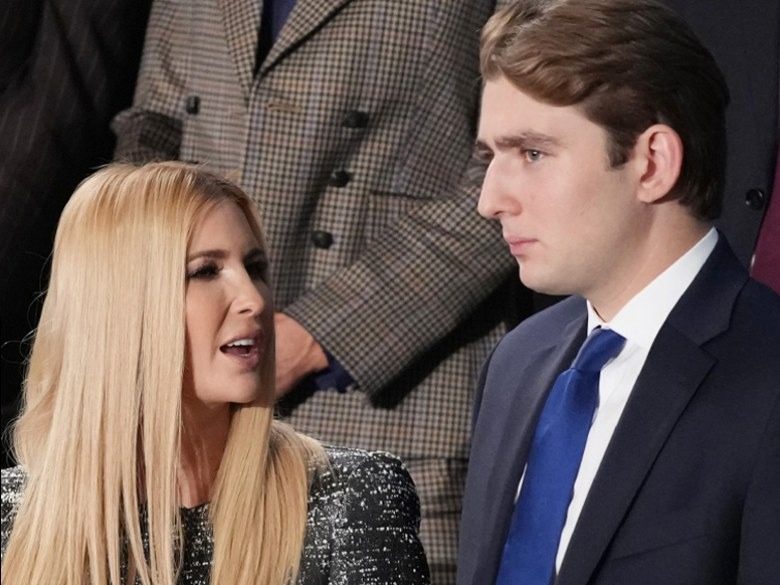

When the president took the stage and spoke of faith, strength, and what he described as a “tremendous renewal” in American life, every detail of the evening appeared carefully arranged. The lighting, the applause, the placement of family members behind him — all of it reinforced the image of unity and continuity. At the center stood Donald Trump, projecting confidence. Seated nearby, Melania Trump was acknowledged warmly from the podium, while Ivanka Trump maintained her composed, diplomatic smile. And beside her, making one of his first significant public appearances as an adult, was Barron Trump.
It was meant to be a tableau of strength — a political family aligned in purpose. Yet within that polished presentation, a fleeting and reportedly private exchange drew unexpected attention. As the speeches unfolded and the cameras scanned the audience, Ivanka leaned toward her younger brother and quietly asked, “What are you doing on…?” The question, seemingly cut short or lost in the surrounding noise, was met with a reply that surprised those who later claimed to have overheard it: “I’m not sure, I couldn’t be a***d.”
Whether interpreted as sarcasm, fatigue, or a moment of candid teenage bluntness, the remark stood in stark contrast to the carefully rehearsed rhetoric echoing across the room. In an environment built on messaging discipline and symbolic gestures, the response felt unfiltered. It did not sound like politics. It sounded like someone young, possibly overwhelmed, navigating a world he did not entirely choose.
For Barron, adulthood has arrived under extraordinary circumstances. Born into one of the most scrutinized political families in modern American history, his life has unfolded under relentless media attention. Unlike his older siblings, who embraced public-facing roles in business and politics, Barron has largely remained out of the spotlight. His appearances have been rare, his words even rarer. That scarcity has only amplified curiosity about him.
The alleged exchange with Ivanka hinted at something relatable beneath the grandeur. It suggested that even within a family synonymous with ambition and control, uncertainty persists. The comment — vague, half-censored, and tinged with indifference — carried the weight of someone caught between expectation and autonomy. In a family narrative centered on purpose and power, it introduced ambiguity.
Political events often function as theater. Every smile, every gesture, every camera angle reinforces a storyline. Families become symbols; individuals become extensions of a broader message. On this particular night, unity and renewal were the themes. Yet it was that unscripted moment — brief and almost throwaway — that resonated most strongly with observers.
Perhaps because it felt human.
In a hall filled with applause lines and declarations of destiny, a young man’s uncertain reply pierced the choreography. It reminded audiences that behind the symbols stand real people, navigating pressures invisible to most. If the evening was designed to project clarity and momentum, that small exchange suggested something more complex: that even within power’s inner circle, not every role is clearly defined, and not every participant feels entirely certain of their place in the script.