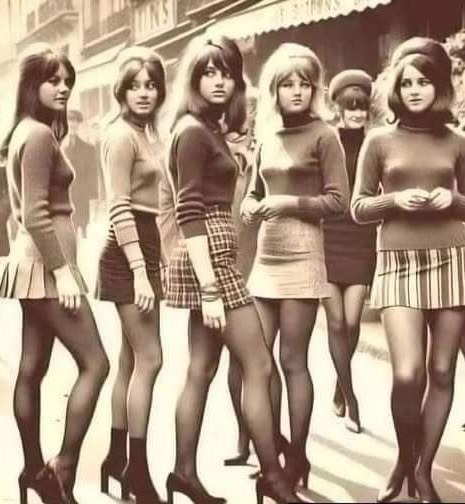
At first glance, the image appears to be nothing more than a charming vintage street photograph. A line of young women stands confidently along what looks like a European sidewalk from decades past. Their skirts are daringly short for the time, their hair styled in fashionable waves or neat updos, and their expressions carry a quiet boldness that feels ahead of its era. It has all the ingredients of a nostalgic snapshot — the kind that captures youth, style, and a fleeting cultural moment. Most people glance at it briefly, smile at the retro aesthetic, and continue scrolling.
But something about the image lingers.
If you pause for a moment and study it more carefully, a subtle unease begins to form. At first, it’s hard to pinpoint why. The women’s legs are aligned almost too perfectly. Their posture mirrors one another in a way that feels more choreographed than natural. Their body proportions seem strikingly consistent — almost mathematically so. Viewers often assume this “odd” feeling comes from strict fashion norms of the era or perhaps a posed modeling shot. That explanation feels logical enough. Yet the deeper you look, the less convincing that assumption becomes.
The real clue isn’t in their outfits. It isn’t in their stance. It isn’t even in the background architecture.
It’s in their faces.
Look closely — not casually, but intentionally. Study the eyes. The shape of the brows. The curve of the nose. The structure of the jawline. One by one, the small details begin to align in a way that can no longer be ignored. The realization arrives slowly, then all at once: every woman in the photograph has the exact same face.
Not similar. Identical.
The same cheekbones. The same subtle tilt of the lips. The same spacing between the eyes. Though their heads are angled slightly differently and their expressions vary just enough to appear natural, the underlying facial structure never changes. It’s the same woman, repeated again and again across the frame.
What initially looked like a group of friends sharing a moment on a city street is, in fact, a carefully constructed illusion.
Long before digital editing software made image manipulation effortless, photographers were already experimenting with visual trickery. Creating this image would have required remarkable patience and precision. The same woman would have been photographed multiple times, carefully repositioned for each shot. The negatives would then be combined in a darkroom through meticulous compositing techniques. Any slight misalignment could have ruined the illusion. The seamlessness is what makes it so impressive.
And that’s where the true brilliance lies.
The photograph isn’t simply a vintage fashion statement — it’s a masterclass in perception. Our brains are wired to assume diversity when we see multiple figures in a scene. We don’t immediately question uniqueness because we expect it. The mind fills in details automatically, convincing us that we’re seeing different individuals even when the evidence suggests otherwise.
Once you recognize the repetition, the illusion collapses instantly. What seemed ordinary becomes extraordinary. The casual street scene transforms into a clever psychological puzzle. You can’t go back to seeing it the same way again.
Ultimately, the image serves as a quiet reminder: perception is fragile. Even without modern technology, reality can be carefully staged. Sometimes, the most surprising truths aren’t hidden in the shadows — they’re standing right in front of us, daring us to truly look.