
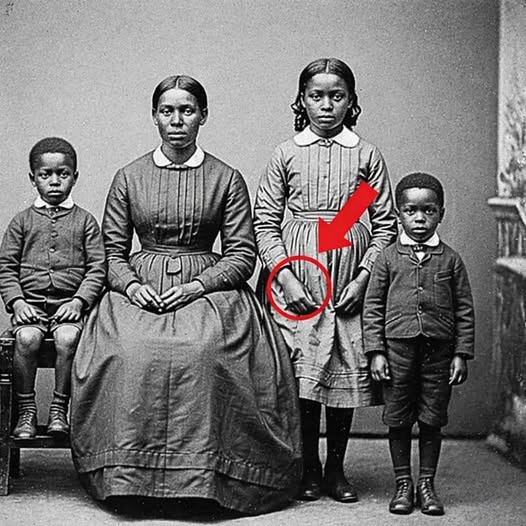
At first glance, the photograph looks like thousands of others taken in the 19th century. A mother sits stiffly in a studio chair, her posture perfectly straight, her expression calm but serious. Two young boys stand on either side of her, dressed neatly in formal clothing that was likely chosen carefully for the occasion. Beside the mother stands her daughter, slightly older than the boys, composed and unsmiling like the rest of the family. The scene appears formal, almost rigid, reflecting the photographic style of the time. It looks like a traditional family portrait meant to show unity, respectability, and stability.
But the longer someone studies the photograph, the more unsettling it becomes.
At first, the viewer may notice the serious expressions, typical of portraits from that era when long exposure times required people to remain still for extended periods. Then the eye drifts slowly across the image. The clothing, the stiff posture, the careful arrangement of the family — everything appears ordinary. But when the viewer’s gaze reaches the girl’s hand, the feeling of normalcy suddenly fades.
Her right hand does not look like the others.
The fingers appear shorter than expected, possibly fused or unevenly formed. They are held in a position that feels intentional, as if the girl was aware of how they appeared. This detail is not the result of damage to the photograph, nor is it a blur caused by movement. Photography in the 1800s required careful preparation, precise posing, and long exposure times. Every element captured in the frame was deliberate.
That is what makes the image so intriguing. The family clearly chose to include this detail rather than hide it.
In the 19th century, visible physical differences were often treated very differently than they are today. Many children born with congenital conditions were kept out of public view. Families sometimes avoided public gatherings or photographs entirely, fearing judgment or social stigma. Medical knowledge was limited, and many conditions were misunderstood or unfairly associated with shame.
The girl in this photograph was likely born with a congenital hand condition, possibly syndactyly — a condition where fingers are fused together — or another form of limb malformation that occurred during development. At the time the photograph was taken, there were no modern surgical procedures to correct such conditions. Physical therapy and medical interventions that exist today simply did not exist then.
Because of this, many families chose to conceal physical differences whenever possible.
Yet this family made a different choice.
They posed together and allowed their daughter to stand clearly in view, without hiding her hand behind furniture or clothing. She is not positioned in the background or partially obscured. Instead, she stands upright beside her mother, exactly where a daughter would normally stand in a formal portrait.
That choice carries a quiet but powerful meaning.
Family portraits in the 1800s were not casual photographs. They were expensive and carefully planned events. Families often visited a studio only once or twice in a lifetime to capture an image that would represent them for generations. Every detail — from clothing to posture — was selected with intention.
By allowing their daughter’s hand to remain visible, the family preserved an honest version of themselves.
Some historians believe the decision may have been practical. Hiding the condition might have sparked rumors or speculation. Showing it openly allowed the family to control the narrative. Others suggest the possibility that the girl herself did not wish to hide her hand. Though we cannot know her thoughts, her posture in the photograph appears calm and steady, almost as if she understood that she was being seen exactly as she was.
What makes the photograph so powerful today is not simply the unusual detail of the hand, but the message behind it.
In a time when many people felt pressure to conceal anything considered imperfect, this family allowed the truth to remain visible. The image captures not only their appearance, but also a quiet moment of dignity.
That single hand, preserved in a photograph more than a century old, continues to tell a story about acceptance, courage, and the strength of simply being seen.