Two pilots died in seconds.
Metal screamed, fuel burned, and LaGuardia’s runway became a war zone.
Yet somehow, a 26–year flight attendant was hurled over 100 meters, still strapped to her seat… and lived. Her daughter calls it a miracle. Investigators call it “extraordinary.” The truth of what happened inside that cabin will shoc…
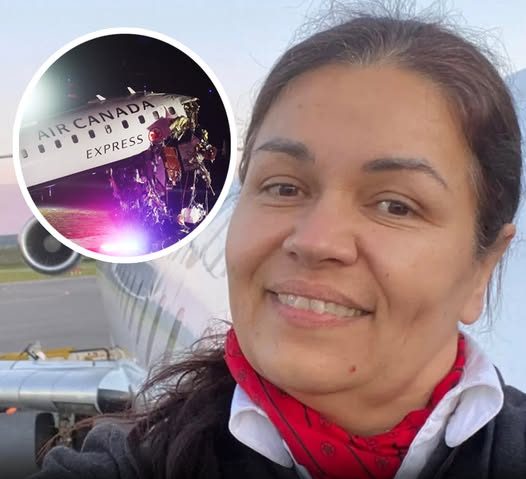
When Air Canada Jazz Flight 8646 collided with a fire truck on LaGuardia’s Runway 4, it should have been the kind of impact no one walks away from. The cockpit was destroyed, killing both pilots instantly and injuring dozens. Amid the chaos, veteran flight attendant Solange Tremblay’s jump seat tore free and was blasted more than 100 meters from the aircraft, with her still strapped in. Rescuers found her alone on the tarmac, broken but breathing.
Her daughter, Sarah, calls it nothing less than a miracle. Surgeons worked to repair multiple fractures, including a shattered leg, while investigators struggled to understand how anyone in that part of the plane could survive. Experts point to the heavily reinforced jump seat, designed to endure extreme crash forces so crew can lead evacuations. This time, that engineering didn’t just protect passengers; it gave one mother a second chance at life.
The crash unfolded in a matter of seconds, but its impact will be studied for years.
On what began as a routine operation, Air Canada Jazz Flight 8646 was preparing for movement on the runway at LaGuardia Airport, one of the busiest and most tightly coordinated airports in the United States. Ground crews, air traffic control, and pilots rely on near-perfect timing in such environments. But on that day, something went catastrophically wrong.
As the aircraft moved along Runway 4, it collided with an airport fire truck—an impact so violent that witnesses described it as sounding like an explosion. The nose of the aircraft absorbed the full force of the collision. Inside the cockpit, there was no time to react. Both pilots were killed instantly, their section of the plane sustaining devastating damage.
Behind them, chaos erupted.
Passengers were thrown forward as the aircraft jolted to a halt. Overhead compartments burst open, sending luggage flying. The smell of burning fuel quickly filled the cabin as fire crews rushed toward the wreckage. Survivors later described the moment as “pure confusion,” with screams, smoke, and the deafening sound of tearing metal overwhelming every sense.
But amid that chaos, one story would defy logic.
At the rear section of the aircraft, veteran flight attendant Solange Tremblay was seated in her jump seat—a specialized, reinforced seat designed for crew safety during takeoff, landing, and emergencies. When the impact occurred, the force ripped her seat from its mounting. Still strapped in, Tremblay was violently ejected from the aircraft.
She was thrown more than 100 meters across the tarmac.
Rescuers arriving at the scene initially focused on the burning wreckage, expecting that anyone ejected at such a distance would not have survived. But then they saw her—alone on the runway, still secured in her seat, barely conscious but alive.
Emergency responders rushed to her side. She had suffered multiple severe injuries, including a shattered leg and extensive trauma across her body. Yet she was breathing. Against every expectation, she had survived an event that experts would later describe as “virtually unsurvivable.”
Her daughter, Sarah Tremblay, would later speak publicly, calling her mother’s survival nothing short of a miracle. “There’s no explanation that makes sense,” she said. “She shouldn’t be here—but she is.”
Medical teams worked for hours to stabilize Tremblay. Surgeons performed complex procedures to repair fractures and internal injuries. While her recovery is expected to be long and difficult, doctors have expressed cautious optimism about her survival.
Meanwhile, investigators have launched a full inquiry into the crash.
Authorities, including aviation safety experts and federal investigators, are examining every detail—from communication logs to ground vehicle positioning—to determine how the fire truck ended up in the aircraft’s path. Early findings suggest a breakdown in coordination, but no final conclusions have been released.
One of the most studied aspects of the crash is the survival of Tremblay herself.
Aviation engineers point to the design of modern jump seats as a critical factor. Unlike passenger seats, these are built to withstand extreme forces, with reinforced frames and multi-point harness systems intended to keep crew members secured during high-impact scenarios. In this case, that design may have absorbed enough energy to prevent immediate fatal injuries—even as the seat itself detached.
Still, survival under such conditions remains extraordinarily rare.
Experts emphasize that a combination of factors—angle of impact, trajectory, surface conditions, and sheer chance—likely contributed to Tremblay’s survival. “You can design for safety,” one investigator noted, “but you can’t design for miracles.”
The crash has once again raised urgent questions about runway safety, coordination between ground vehicles and aircraft, and the systems in place to prevent such incidents. At a major airport like LaGuardia, where operations are constant and complex, even a single miscommunication can have catastrophic consequences.
For the families of the victims, the tragedy is immeasurable. Two pilots lost their lives doing their job, and dozens of passengers were injured in an instant that changed everything.
And yet, in the middle of that devastation, one life held on.
Thrown across a runway, surrounded by wreckage and fire, Solange Tremblay survived. Not without scars, not without pain—but alive.
For her daughter, for her family, and for those who pulled her from the tarmac, that survival is more than extraordinary.
It is something they may never fully be able to explain.