
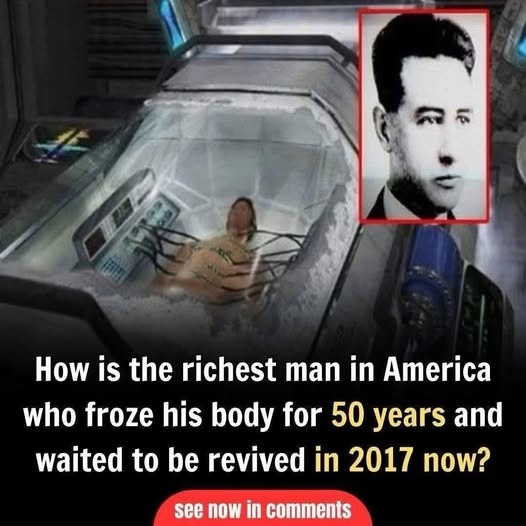
In the 1960s, a wealthy American businessman became consumed by a single, powerful idea: defeating death. He had already achieved what many spend their entire lives chasing — immense wealth, influence, and recognition. Yet despite his success, one undeniable truth haunted him. No matter how much money he possessed, he could not buy his way out of mortality.
Determined to challenge what seemed inevitable, he turned his attention to a radical and highly controversial scientific concept known as Cryonics — the preservation of the human body at extremely low temperatures after legal death, with the hope that future medical advancements might one day restore life. At the time, the idea was viewed by many as science fiction. But to him, it represented possibility.
In 1967, his extraordinary plan became reality. After his death, his body was carefully prepared and placed inside a cryogenic chamber. Surrounded by ice and liquid nitrogen, he was sealed away in suspended stillness. Attached to his case was a simple but bold instruction: “Do not thaw until the year 2017.”
The world moved on.
Over the decades, his name faded from headlines, but whispers of his story lingered. Some referred to him as “the man who refused to die.” To supporters, he was a visionary — someone brave enough to place faith in the future of science. To critics, he was a symbol of hubris, a wealthy man so terrified of death that he clung to an unproven gamble.
Meanwhile, technology advanced at breathtaking speed. Medicine made breakthroughs once thought impossible. Organs were transplanted. Genes were edited. Artificial intelligence transformed entire industries. Each new discovery fueled the question: would the frozen man’s gamble pay off?
When 2017 finally arrived, curiosity resurfaced. Researchers and scientists revisited his case, examining both his preserved body and the progress of modern science. The reality, however, was sobering. Despite decades of advancement, the ability to revive a fully frozen human body remained far beyond reach. Cryonics had succeeded in preservation, but not in resurrection.
His body remained intact, remarkably preserved by the ultra-low temperatures. In many ways, he was frozen in time — a relic of 1960s optimism about technology and human progress. But bringing him back? That was still the stuff of theory, not reality.
Even today, his chamber remains under careful monitoring. Facilities dedicated to cryonic preservation continue to maintain bodies and heads of individuals who made similar choices, waiting for a scientific breakthrough that may or may not come. His case, in particular, is frequently referenced in discussions about longevity research and the ethics of life extension.
Scientists continue exploring ways to slow aging, repair cellular damage, and extend human lifespan. While none can yet reverse death after cryonic freezing, the broader pursuit of longer and healthier lives continues to accelerate. His preserved form serves as both inspiration and warning — a reminder of humanity’s relentless desire to overcome its limits.
Whether he will ever open his eyes again remains uncertain. Perhaps future generations will see him as a pioneer who was simply born too early. Or perhaps history will remember him as a man who tried to outwit nature itself.
He did not die chasing immortality in the traditional sense. Instead, he chose something stranger — he chose to wait.