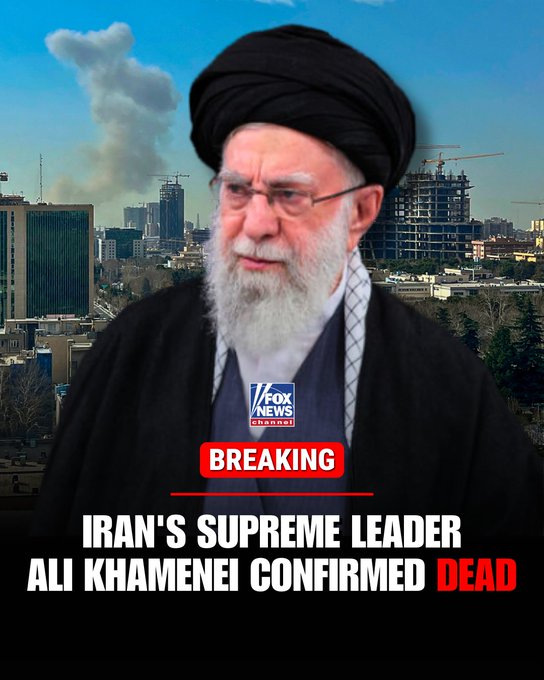
The world is on edge following explosive and unverified reports claiming that Ali Khamenei, Iran’s Supreme Leader, was killed in a massive Israeli strike on Tehran. The claims, first attributed to Israeli government sources, allege that Khamenei died during a coordinated military operation targeting high-level Iranian leadership compounds amid escalating tensions between Iran and Israel.
According to those reports, the strike was part of a broader campaign aimed at crippling strategic military infrastructure and eliminating senior figures within Iran’s command structure. Israeli officials stated that “significant leadership targets” were hit, though they stopped short of publicly providing detailed confirmation regarding Khamenei specifically. Benjamin Netanyahu has not personally confirmed the reports in a formal address, further fueling uncertainty.
However, Iranian state media swiftly rejected the claims, labeling them “psychological warfare” and accusing Israel of spreading disinformation to destabilize the region. Officials in Tehran insisted that Khamenei remains alive and is actively “commanding the situation.” As of now, there has been no independent verification from international observers or third-party intelligence sources confirming his death.
The conflicting narratives have created one of the most tense and confusing geopolitical moments in recent years. In an era where information spreads instantly, rumors and unverified claims can move global markets and shift diplomatic dynamics within hours. That appears to be exactly what happened.
Financial markets reacted sharply. Oil prices spiked amid fears that confirmation of Khamenei’s death could trigger a wider regional war involving proxy groups and allied forces. Governments across Europe and Asia reportedly convened emergency consultations, urging restraint and calling for verified information before drawing conclusions. The United States responded cautiously, with officials stating they are “monitoring the situation closely.”
If the reports were to be confirmed, the implications would be enormous. Khamenei has led Iran since 1989, assuming power after the death of Ruhollah Khomeini. As Supreme Leader, he holds ultimate authority over Iran’s military, judiciary, intelligence services, and major state decisions. Unlike Iran’s elected president, the Supreme Leader is the highest-ranking political and religious authority in the country.
A sudden leadership vacuum at that level could trigger complex constitutional procedures. While Iran does have mechanisms for succession through its Assembly of Experts, analysts warn that an abrupt and violent transition could spark internal power struggles among political factions, the Revolutionary Guard, and clerical institutions. It could also provoke retaliation against Israel or escalate tensions with regional rivals.
On social media, reactions have been intense and polarized. Hashtags related to Khamenei began trending globally within hours, with some users expressing disbelief and others voicing deep concern about what might follow. The speed at which the story spread highlights the volatile intersection of geopolitics and digital information flow.
For now, the key word remains “unconfirmed.” Without clear evidence, independent verification, or official acknowledgment from Tehran, the claims remain allegations rather than established fact. In moments of high tension, misinformation can travel faster than reality.
Regardless of the outcome, what is undeniable is that tensions between Israel and Iran have reached a critical point. Whether this turns out to be a misinformation campaign, a misinterpretation, or a historic turning point, the region is on high alert — and the world is watching closely as this developing story unfolds.