
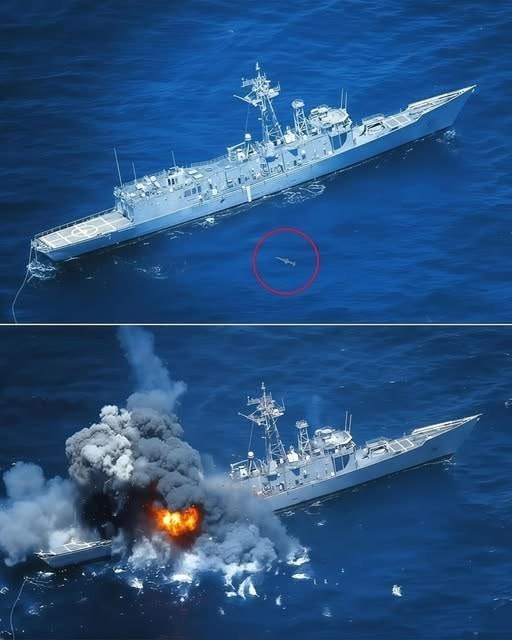
The former USS Rodney M. Davis (FFG-60), once an active guided-missile frigate of the United States Navy, met its final fate not in combat, but during a carefully planned and controlled SINKEX (sinking exercise). The vessel was deliberately sunk after being struck by an AGM-84 Harpoon anti-ship missile, marking the end of its long and honorable service life. Rather than representing a wartime loss, the event symbolized a transition from operational duty to a final contribution in support of naval training and weapons evaluation.
Commissioned in 1982, USS Rodney M. Davis was part of the Oliver Hazard Perry-class frigate, a class of warships designed during the height of the Cold War. These frigates were primarily built for anti-submarine warfare, convoy escort, and the protection of carrier battle groups. With a balanced combination of missile systems, naval guns, and anti-submarine capabilities, the class played a crucial role in maintaining maritime security and deterrence during a period of intense geopolitical rivalry.
The ship was named in honor of Rodney Maxwell Davis, a United States Marine who was posthumously awarded the Medal of Honor for his heroic actions during the Vietnam War. Carrying his name, the frigate embodied a legacy of courage and dedication, serving across multiple decades and theaters of operation. Throughout its active years, the vessel participated in numerous patrols, multinational exercises, and maritime security missions. It operated in regions spanning the Pacific, the Middle East, and beyond, contributing to joint operations and strengthening alliances with partner nations.
After decades of service, the ship was decommissioned as newer and more advanced platforms entered the fleet. However, even in retirement, the vessel still had one final role to fulfill. Selected for a SINKEX, the ship became part of a live-fire training exercise designed to test weapons systems under realistic conditions. Before the event, extensive preparations were undertaken to ensure environmental compliance. Hazardous materials, fuels, and sensitive equipment were carefully removed in accordance with strict environmental protection standards. These steps ensured that the sinking would not pose unnecessary risks to marine ecosystems.
During the exercise, an AGM-84 Harpoon missile was launched against the vessel. The Harpoon, a widely used anti-ship missile known for its sea-skimming capability and precision targeting, struck the ship as planned. Analysts and observers gathered valuable data on the missile’s performance, impact effects, and the structural resilience of the ship. Such exercises provide critical insights that help refine tactics, improve ship survivability designs, and enhance overall naval readiness.
For former crew members, the sinking was undoubtedly emotional. Many had served aboard the ship during significant moments of their careers, forming bonds not only with fellow sailors but with the vessel itself. Watching it disappear beneath the waves marked the closing of a chapter filled with shared experiences, challenges, and pride.
Yet the final mission of USS Rodney M. Davis reflected the enduring principle of service. Even in its destruction, the ship contributed to the preparedness of future sailors and the development of more capable fleets. Its legacy lives on not only in history books, but in the lessons learned from its final exercise at sea.