The room erupted in laughter, the kind that rolls across a space and lingers in the air long after the moment has passed. Crystal glasses clinked softly against polished silverware, and camera flashes cut through the warm glow of chandeliers. It was a night designed for elegance and diplomacy — a White House State Dinner where every word, every gesture, carried weight.
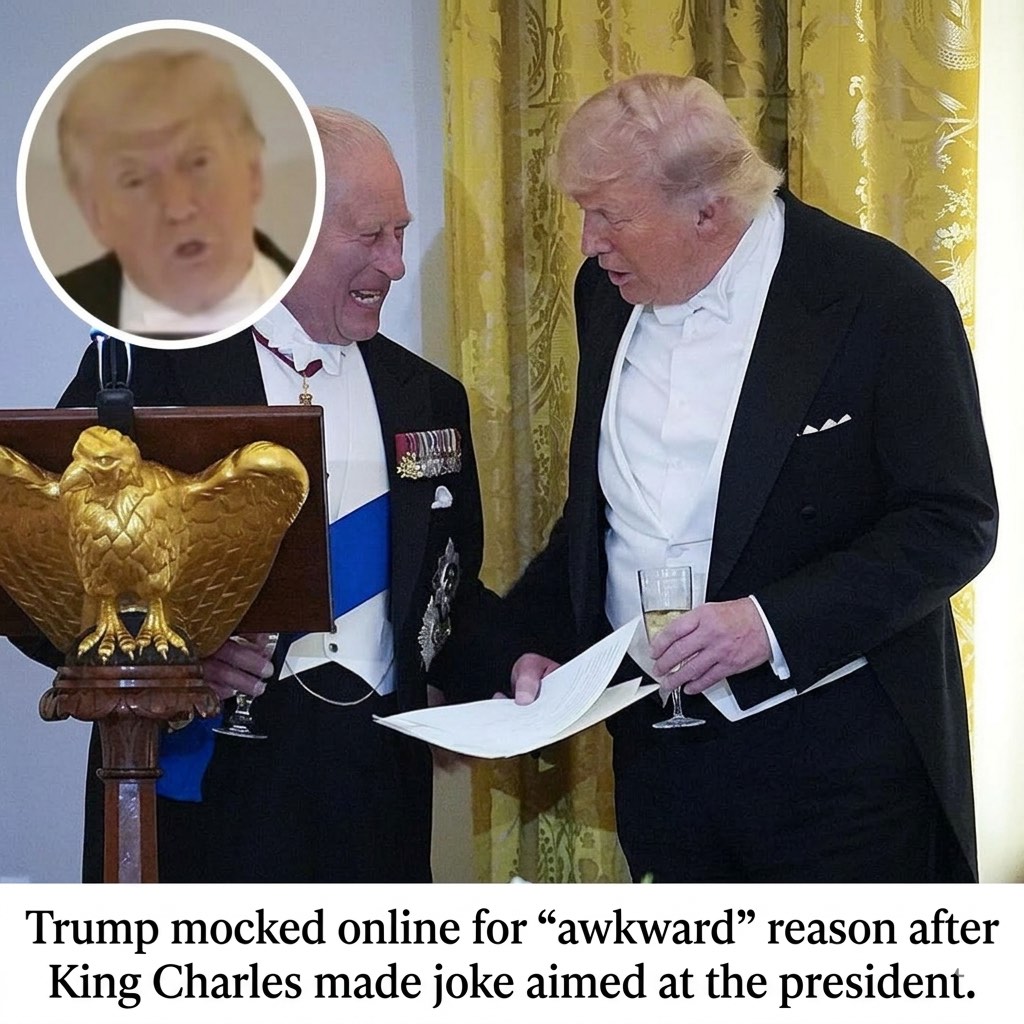
At the center of it all stood King Charles III, delivering a speech that balanced formality with charm. Then came the line — a carefully crafted punchline that seemed light on the surface but carried a sharper edge underneath. In an instant, the room shifted. Laughter spread quickly, effortlessly. Guests leaned toward one another, smiles widening as they caught the meaning behind the words.
Across the room, Donald Trump smiled too. But his expression didn’t quite match the ease of the crowd. There was a flicker of hesitation, a momentary disconnect — subtle, but noticeable. It was the kind of reaction that doesn’t need explanation in real time but becomes unmistakable when replayed later.
And replayed it was.
Within hours, clips from the evening flooded social media. The moment took on a life of its own, dissected frame by frame, shared across platforms, and reframed through countless perspectives. Many praised the king’s wit, calling it a perfect example of understated humor delivered with precision. Others focused on Trump’s reaction, interpreting his expression as confusion, discomfort, or even quiet irritation.
But what unfolded that evening was more than just a joke landing well.
It was a lesson in layered communication — a reminder that humor, in the hands of someone skilled, can carry both diplomacy and critique at the same time. By referencing Trump’s earlier remark at the World Economic Forum in Davos — where he once suggested Europe might end up “speaking German” — the king subtly flipped the narrative. Without raising his voice or breaking protocol, he invoked history, hinting at Britain’s own complex and often dominant role in shaping the world, including its former colonies.
The brilliance of the moment was in its delivery. It didn’t feel like an attack. It felt like a story — one that the audience immediately understood. The laughter that followed wasn’t just about the humor; it was about recognition. A shared awareness of the deeper meaning woven into the words.
For many viewers online, the clip became symbolic. It represented more than a witty exchange; it highlighted a contrast in style and substance. On one side, a monarch known for measured speech and historical awareness. On the other, a former president often defined by directness and spontaneity.
Trump’s reaction, looped endlessly, became its own narrative. That fixed smile, the searching eyes, the slight pause — each detail was interpreted, debated, and amplified. In the age of viral moments, even a fraction of a second can shape public perception.
In the end, the scene at the State Dining Room wasn’t just entertaining — it was revealing. It showed how power can be expressed quietly, how history can be referenced without being explicitly stated, and how a single moment can capture the difference between two approaches to leadership.
Two men stood in the same room, under the same lights, sharing the same stage. Yet what people took away from that night was not unity, but contrast — a reminder that sometimes, the most powerful statements are the ones delivered with a smile.