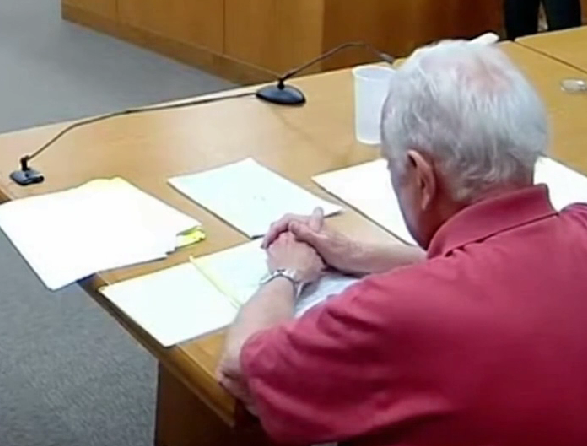
A quiet neighborhood dispute has turned into a powerful legal moment highlighting the importance of constitutional rights—specifically, the protection against unlawful searches and seizures under the Fourth Amendment.
The situation began when a man returned home from a routine doctor’s appointment, only to discover something deeply unsettling. The lock on his private shed had been cut, the door damaged, and his car—stored inside for decades—was gone.
Confused and alarmed, he immediately contacted local authorities. What he learned next only added to his frustration: the city had taken the vehicle.
According to officials, the car had been listed on an abatement schedule. Because it had not been registered for over 30 years, it was classified under municipal code as an “unlicensed inoperable vehicle.” Under that code, such vehicles are considered public nuisances—even if stored on private property.
But the homeowner strongly disagreed with that interpretation.
The vehicle, he explained, had been kept inside a closed, woodsided shed, completely out of public view. No neighbors could see it, and it wasn’t causing any visible disruption. From his perspective, there was no justification for the city to enter his property, damage his shed, and remove his car—especially without any warning or legal authorization.
The dispute escalated into a courtroom hearing, where the legality of the city’s actions came under intense scrutiny.
During the proceedings, a key issue quickly emerged: whether the city had the legal authority to forcibly enter private property without a warrant. The judge pressed city representatives to identify any section of the municipal code that explicitly allowed them to break a lock and access a secured structure.
No such provision could be found.
That’s when the judge made his position clear.
In a firm and direct statement, he identified the city’s actions as a violation of the Fourth Amendment—the constitutional protection that guards citizens against unreasonable searches and seizures. Entering private property, cutting a lock, and removing personal belongings without a warrant or proper legal process crossed a line that could not be ignored.
The courtroom moment was decisive.
The judge ordered the city to return the vehicle to its original location—the shed—by 5:00 p.m. that same day. In addition, the city was instructed to cover the cost of repairing the damaged door.
The ruling served as a sharp reminder that even local governments must operate within constitutional limits. While cities may have codes and regulations aimed at maintaining order and addressing nuisances, those rules do not override fundamental rights.
This case also raises broader questions about how far municipalities can go when enforcing local ordinances. While abandoned or unregistered vehicles can present legitimate concerns, enforcement actions must still respect due process and property rights.
For the homeowner, the experience was both shocking and validating. What began as confusion and panic ended with a clear acknowledgment from the court that his rights had been violated.
Legal experts note that situations like this are not just about a single vehicle or property dispute—they reflect the ongoing balance between government authority and individual freedoms. The Fourth Amendment remains a cornerstone of that balance, ensuring that citizens are protected from overreach.
In the end, the message from the courtroom was unmistakable: no matter the circumstances, the Constitution still applies.