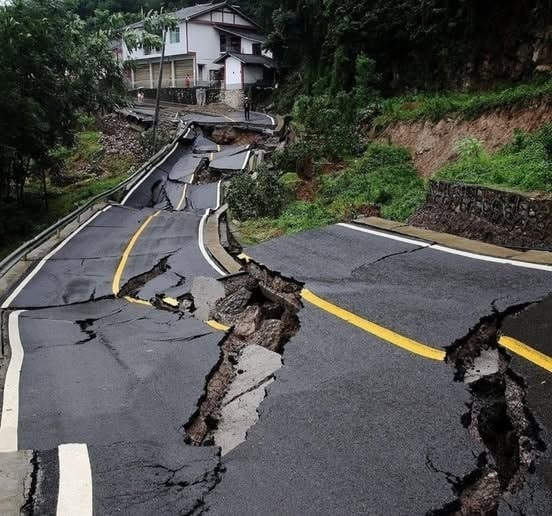
In the early hours of Monday, January 1, 2026, a major seismic event shook the borderlands where Myanmar, Southern China, and Northern Thailand converge. At precisely 3:42 a.m. local time, the ground violently shifted, producing a powerful earthquake that measured 7.7 on the Richter scale. Though the tremor itself lasted only a few fleeting moments, its consequences are expected to reverberate across the region, affecting humanitarian efforts, regional stability, and long-term development plans for years to come.
Understanding the Earthquake: Geological Background
The earthquake’s epicenter, according to the U.S. Geological Survey (USGS), was located in the mountainous terrain where Myanmar’s Shan State meets China’s Yunnan province. With a relatively shallow focal depth of about 10 kilometers, the quake’s destructive energy reached the surface with exceptional force, causing widespread structural damage and amplifying human vulnerability. Shallow earthquakes tend to be more destructive than deeper ones because seismic energy has less earth material to absorb it, which means more intense shaking at the surface.
Myanmar’s Unique Seismic Risk
Myanmar lies at a geologically complex intersection, where four tectonic plates—the Indian, Eurasian, Sunda, and Burma plates—interact. This convergence makes the region highly susceptible to seismic events. The January 2026 quake is believed to have occurred along the Sagaing Fault, a prominent north-south trending fault line in Myanmar. The Sagaing Fault has historically been a hotspot for earthquakes due to its strike-slip motion, where tectonic plates move horizontally against each other. This sideways movement produces powerful lateral shaking that can be catastrophic for buildings and infrastructure.
Geologists have identified “seismic gaps” along the Sagaing Fault—stretches that have not ruptured in over a century. These gaps accumulate tectonic stress over time, increasing the likelihood of a significant future earthquake. The January event appears to have released pressure in one such critical segment, effectively filling a long-overdue seismic gap.
Immediate Human Impact
Initial reports indicate that at least 48 people lost their lives, while over 300 suffered injuries. These figures may be underestimates due to the chaotic situation on the ground. Urban centers like Lashio experienced disproportionate destruction because many of the buildings are older, masonry-based, and densely packed, which magnifies the danger when shaking occurs.
Beyond the numbers, the human experience captures the true horror of the quake. Survivors described the sensation as the ground moving in rolling waves, a phenomenon known as soil liquefaction. In such cases, saturated soil temporarily behaves like a liquid, undermining foundations and causing structures to collapse. One resident, Myo Thant, recounted fleeing his collapsing home, describing a “loud, deafening roar” that preceded the shaking. This sound was generated by the high-frequency primary waves (P-waves) of the earthquake, which travel faster than the more destructive secondary waves (S-waves).
Rescue Operations and Challenges
Humanitarian response efforts have been severely hampered by both the natural and logistical challenges presented by the quake. Rescue teams are racing against time, often referred to as the “Golden Hour” in disaster medicine—the critical period when medical intervention is most likely to save lives. In Shan State, however, mountainous terrain and landslides have blocked major roads, extending response times dangerously.
Communication networks have also suffered significant damage. Power outages and destroyed cellular towers have left entire communities isolated, making it difficult for authorities to coordinate aid or even determine how many people are trapped or missing. These combined factors have transformed what is already a humanitarian disaster into a highly complex crisis.
Regional Coordination and Geopolitical Sensitivities
The location of the earthquake along sensitive international borders has added another layer of complexity to relief operations. China, whose Yunnan province borders the affected region, has mobilized rescue teams, but cross-border coordination is often delicate due to political considerations. Similarly, Thailand has played a vital role, particularly in cities like Chiang Rai and Chiang Mai, where mass evacuations have tested the readiness of local emergency management systems. Thailand has become a hub for international NGOs, serving as a logistical center for the delivery of food, medicine, and other critical resources to the affected populations in Myanmar.
Long-Term Consequences and Lessons Learned
While earthquakes are natural events, the scale of their impact is largely influenced by human vulnerability. Rapid urbanization in Southeast Asia has often outpaced the enforcement of modern seismic building codes. In cities such as Lashio and Mandalay, many structures are “non-engineered” and lack reinforced steel or flexible foundations capable of withstanding a 7.7 magnitude shock. The post-quake recovery phase presents an opportunity to implement the concept of “Building Back Better,” moving beyond slogans to enforce strict regulations that enhance resilience against future disasters.
The earthquake has also highlighted secondary threats that often follow major natural disasters. Health risks emerge when water and sanitation systems are damaged, potentially leading to outbreaks of waterborne diseases such as cholera and dysentery. In addition, psychological trauma is a major concern, especially for children who have lost their homes or schools. Survivors may experience long-term mental health challenges, including post-traumatic stress disorder (PTSD).
The Urban Planning Imperative
Urban planning and disaster preparedness are critical to minimizing casualties in future events. Cities in Myanmar and neighboring regions need comprehensive seismic risk assessments to identify vulnerable areas and enforce construction standards. Public education campaigns can also help communities understand how to respond effectively during earthquakes, including evacuation procedures and safe assembly points. Investments in resilient infrastructure—such as earthquake-resistant buildings, emergency shelters, and robust communication systems—can drastically reduce the human toll of future events.
International Cooperation and Solidarity
The January 2026 earthquake underscores the importance of cross-border collaboration in disaster response. In addition to providing immediate humanitarian aid, countries in the region can share expertise in seismic monitoring, emergency logistics, and post-disaster reconstruction. International organizations, including the World Health Organization (WHO) and various NGOs, play a pivotal role in providing both material aid and technical guidance. Strengthening regional disaster preparedness networks can help mitigate the effects of future seismic events and ensure a coordinated response.
Social and Economic Ramifications
The earthquake’s effects extend beyond immediate destruction. Economically, the disruption of trade routes, closure of markets, and loss of infrastructure can slow regional development. Socially, families displaced by the quake may face long-term challenges in rebuilding homes, schools, and livelihoods. Communities must navigate the delicate balance between rapid reconstruction and careful planning to avoid further vulnerability.
Psychological and Community Resilience
One of the less tangible, but equally critical, aspects of recovery is the restoration of hope and community resilience. Human solidarity often proves to be the most powerful resource in the aftermath of disasters. Communities that work together to rebuild not only structures but also social networks tend to recover more quickly and develop stronger coping mechanisms for future shocks. Mental health services, community engagement programs, and educational initiatives for children are essential components of this holistic recovery approach.
Conclusion: A Call for Preparedness and Global Awareness
The earthquake that struck on January 1, 2026, serves as a stark reminder that natural hazards are inevitable, but the severity of disasters is shaped by human decisions, infrastructure, and preparedness. True recovery will require more than just the reconstruction of buildings; it demands a commitment to building resilient societies, capable governments, and cross-border solidarity.
As the dust settles over Shan State and the affected regions of Myanmar, China, and Thailand, the world faces a critical choice: allow this disaster to fade from memory as another tragic event, or transform it into a catalyst for regional cooperation, improved infrastructure, and better preparedness for future natural hazards. The resilience of communities in the face of nature’s most violent forces depends not just on engineering or aid, but on collective human action, empathy, and solidarity.