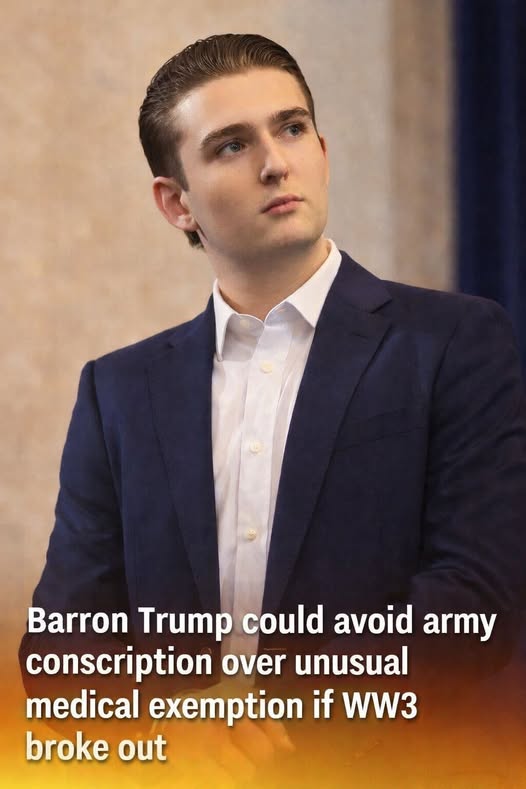
As global tensions continue to dominate headlines and discussions about potential large-scale conflicts resurface, a surprising topic has recently begun circulating online: whether Barron Trump could be drafted if a major war ever required widespread military conscription. The conversation gained traction after speculation emerged suggesting that, under certain circumstances, he might qualify for a rare medical exemption. While the scenario itself remains entirely hypothetical, the debate has sparked widespread curiosity about how military draft rules actually work and who might be required to serve if such a system were ever reintroduced.
In the United States, conscription — commonly referred to as the draft — has not been active for decades. The last time Americans were drafted into the military was during the final years of the Vietnam War. However, the framework for a potential draft still exists through the Selective Service System, a government agency responsible for maintaining records of individuals who could be called upon if a national emergency required rapid expansion of the armed forces. Currently, most men in the United States between the ages of 18 and 25 are legally required to register with this system, even though no active draft is in place.
If conscription were ever reinstated, eligibility would not be determined randomly without review. Instead, individuals would undergo a detailed classification process designed to evaluate whether they are physically, medically, and mentally capable of military service. Factors such as age, physical condition, medical history, family responsibilities, and educational status can all influence the final classification. Those deemed fit could be assigned to military training, while others might receive deferments or exemptions depending on their circumstances.
The renewed discussion about Barron Trump specifically appears to stem from speculation regarding medical classifications that can exempt certain individuals from active duty. The U.S. military maintains strict medical standards to ensure that recruits are capable of handling the intense physical and psychological demands of military life. Conditions affecting mobility, chronic illnesses, certain neurological or psychological disorders, and other serious health concerns can all qualify someone for medical disqualification. However, these determinations are made only after formal medical evaluation by trained professionals and cannot be confirmed through public speculation alone.
Some commentators believe the online debate is also fueled by broader public curiosity about how the rules of the draft would apply to individuals from prominent or politically influential families. Barron Trump is the youngest son of former U.S. president Donald Trump, and public attention often surrounds members of high-profile political families. Throughout American history, questions about whether wealth, influence, or social status might affect draft eligibility have frequently surfaced during times of conflict.
Historically, the draft has been a deeply controversial issue in the United States. During the Vietnam War era, many Americans argued that certain deferments — such as those related to education or occupational roles — allowed some individuals to avoid service while others were sent to the front lines. Protests and public demonstrations became widespread, ultimately contributing to broader debates about fairness, military policy, and government authority.
Supporters of the Selective Service system argue that modern classification procedures are designed to prioritize fairness and military effectiveness. Their goal is to ensure that only those capable of meeting the rigorous demands of military duty are deployed, while individuals with legitimate health limitations or essential civilian roles are appropriately exempted.
Ultimately, the discussion surrounding Barron Trump’s possible eligibility remains purely hypothetical. No active military draft currently exists in the United States, and any decision to reinstate one would require approval from Congress and the president, along with careful national security considerations. For now, the renewed attention serves as a reminder that even policies largely absent from modern life can quickly return to public conversation when global tensions rise and questions about national preparedness come back into focus.