
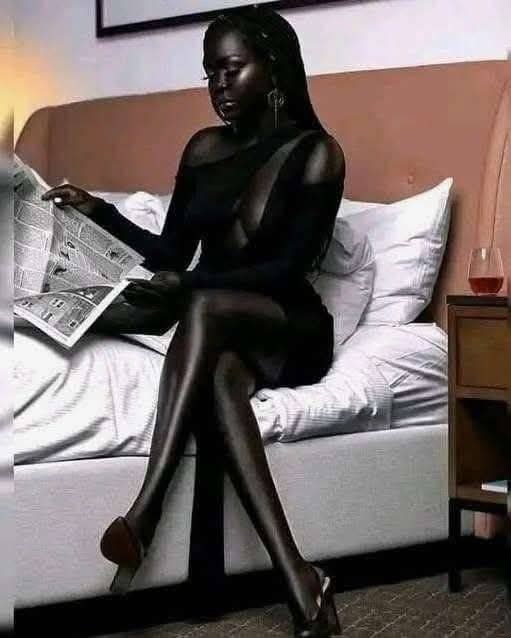
She’s been called the “Queen of Dark,” and the title feels not only fitting, but long overdue. The Sudanese model who has been capturing attention online is turning heads across the globe—not simply because of her striking physical presence, but because of the powerful cultural statement her image represents. In a fashion industry that has historically favored narrow, Eurocentric beauty ideals, her deep, radiant complexion and commanding elegance are boldly rewriting the narrative in a way that is unapologetic, confident, and impossible to ignore.
Photographs of her confidently posing in sleek black attire have spread rapidly across social media platforms, earning admiration, praise, and fascination from thousands. The contrast between her rich skin tone and the minimalist elegance of her styling creates an image that feels both timeless and revolutionary. Her look is bold yet refined, powerful yet graceful, and undeniably magnetic. Every pose carries intention, every expression reflects self-assurance. But beyond the visual impact, what truly resonates with audiences worldwide is the deeper symbolism behind her presence.
She represents a growing global movement—one that celebrates melanin-rich skin tones and challenges outdated perceptions of beauty, worth, and visibility. For decades, darker skin tones were either excluded or pushed to the margins of mainstream fashion, advertising, and media representation. When they did appear, they were often framed through limiting or stereotypical lenses. This long-standing imbalance shaped public perception and silently dictated who was considered “marketable,” “elegant,” or “beautiful.”
Now, models like her are stepping into the global spotlight and reclaiming space that should have never been denied in the first place. Her rise is not an isolated moment but part of a broader cultural shift—one where diversity is no longer treated as a trend or a checkbox, but as a defining strength of modern beauty. Her success challenges the idea that beauty must fit into a single mold, proving instead that it exists across every shade, feature, and background.
The nickname “Queen of Dark” goes far beyond her appearance. It speaks to presence, authority, and the confidence to own space in an industry that once overlooked women who looked like her. It reflects grace under the spotlight and the quiet power of authenticity. Each image she shares becomes more than a fashion statement—it becomes representation. For young girls with deep skin tones who rarely saw themselves reflected in glossy magazines or major campaigns, her visibility sends a clear and affirming message: you belong, you are beautiful, and you are worthy of being seen.
Her influence extends beyond fashion. She embodies a cultural redefinition of elegance—one rooted in confidence, self-acceptance, and pride in identity. The admiration she receives is not just about aesthetics; it’s about what she symbolizes in a changing world that is finally beginning to embrace inclusivity on its own terms.
In the end, her story is not merely about viral images, trending posts, or fleeting headlines. It’s about shifting perspectives and expanding the global definition of beauty. It’s about reminding the world that true elegance is not manufactured by trends or approval, but born from authenticity and self-belief. The spotlight may have found her, but the impact she represents reaches far beyond a single photograph—echoing through generations still waiting to be fully seen.