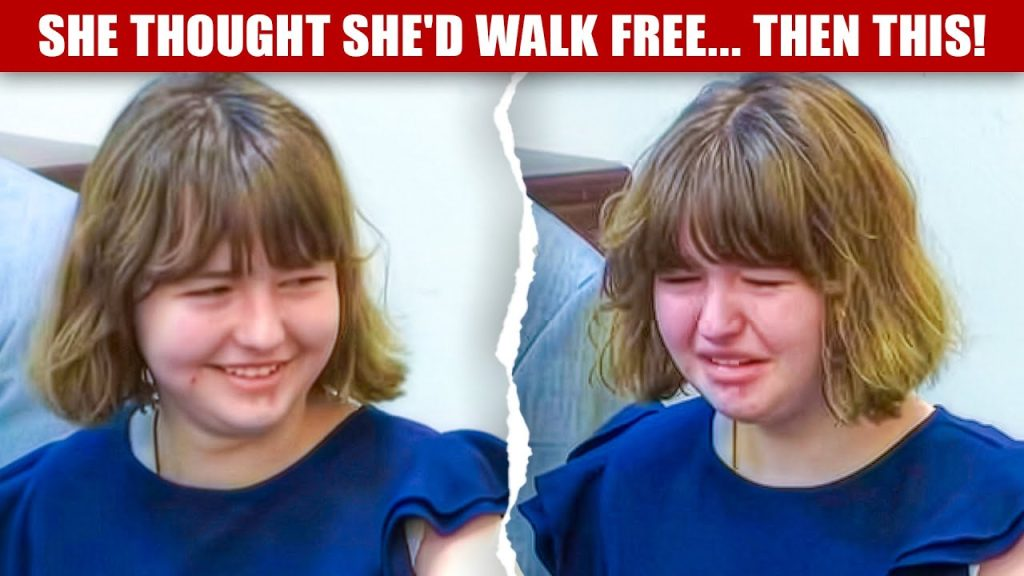
The courtroom was unusually quiet that morning, the kind of silence that feels heavy long before anything happens. Family members filled the benches, some clutching tissues, others staring straight ahead, unwilling to make eye contact with anyone. At the center of it all sat a teenage girl, dressed neatly, her posture calm—almost confident.
To an outside observer, she didn’t look like someone facing the most serious charges imaginable. In fact, when she glanced toward the gallery, there was a faint smile on her face. It wasn’t wide or exaggerated, but it was there—enough to catch the attention of those present. Some whispered. Others shook their heads.
The case had already drawn widespread attention. Authorities had accused the teenager of committing an unthinkable act: killing her mother and shooting her father inside their own home. The father, though severely injured, survived and later became a key witness in the case. The details were disturbing, and the public struggled to reconcile the brutality of the crime with the young age of the accused.
But on this particular day, something felt different.
A Moment of Confidence
As proceedings began, the teen appeared composed. Her defense team had spent weeks building their argument, emphasizing her age, mental state, and the circumstances leading up to the incident. There had been suggestions of emotional distress, possible manipulation, and claims that she did not fully grasp the consequences of her actions.
Some in the courtroom believed the defense might succeed in reducing the severity of the outcome. Others feared justice might not be fully served.
The teenager seemed to lean toward the first possibility.
Observers noted her relaxed demeanor. She whispered occasionally to her attorney, nodded at certain points, and even allowed herself brief smiles. It gave the impression—rightly or wrongly—that she believed she might be walking out of court sooner than expected.
But then, everything changed.
The Video That Changed the Room
Without warning, the prosecution requested to present a key piece of evidence.
A video.
The judge granted permission, and within moments, the courtroom lights dimmed slightly as the screen flickered to life. What followed was something no one present would forget.
The footage, taken from inside the home, revealed moments leading up to the crime. It showed movements, sounds, and fragments of conversation that painted a far more detailed—and chilling—picture than words alone ever could.
Gasps echoed through the room.
Some family members turned away. Others watched in frozen silence. The father, seated carefully with visible signs of his injuries, lowered his head.
And the teenager?
Her smile vanished.
A Shift in Reality
As the video continued, the atmosphere in the courtroom shifted completely. The earlier sense of uncertainty was replaced by something heavier—clarity, perhaps, or the undeniable weight of evidence.
The teen’s posture changed. She sat more rigidly now, her eyes fixed on the screen, no longer whispering to her attorney. The confidence that had been visible just minutes earlier seemed to dissolve with each passing second of footage.
By the time the video ended, the room felt different.
Still.
Tense.
Final.
The prosecution didn’t need to say much afterward. The footage spoke louder than any argument. It provided context, timing, and a sequence of events that was difficult to dispute.
The Victims Behind the Headlines
Amid the legal arguments and courtroom drama, it was easy to lose sight of the human cost behind the case.
A mother had lost her life.
A father, though alive, would carry both physical and emotional scars for the rest of his life. Not only had he survived a violent attack, but the person responsible was his own child.
Relatives described the mother as caring and devoted, someone who had always put her family first. Friends spoke about the father’s strength in surviving and his quiet determination to see the case through.
“This isn’t just a case,” one relative said outside the courthouse. “It’s a family that’s been torn apart.”
Questions Without Easy Answers
As the trial progressed, questions continued to surface.
What could drive a teenager to commit such an act?
Were there warning signs that were missed?
Could anything have prevented it?
Experts often point to a complex mix of factors in cases like this—mental health struggles, family dynamics, external influences—but even then, answers are rarely simple.
For many watching, the case became a painful reminder that tragedy can sometimes unfold behind closed doors, unnoticed until it’s too late.
The Power of Evidence
The turning point in the courtroom underscored something fundamental about the justice system: evidence matters.
While arguments, emotions, and interpretations all play a role, concrete proof can change everything in an instant. The video didn’t just support the prosecution’s case—it reshaped how everyone in the room understood the events.
It also served as a stark contrast to the teenager’s earlier demeanor.
What had seemed like confidence moments before now appeared misplaced.
After the Shock
Following the presentation of the video, proceedings continued, but the tone had shifted irreversibly. The defense faced a much steeper challenge, while the prosecution’s case appeared stronger than ever.
The teenager, once composed, remained quiet for the rest of the session. Gone were the whispers, the faint smiles, the relaxed posture. In their place was a stillness that reflected the gravity of what had just unfolded.
No one in the courtroom spoke as they exited.
A Case That Stays With You
Long after the session ended, those who witnessed it continued to talk about that moment—the exact second when everything changed.
The smile.
The video.
The silence that followed.
Cases like this leave a lasting impact, not just because of the crime itself, but because of the emotions they stir and the questions they raise. They challenge perceptions, force reflection, and remind us of the fragile line between ordinary life and unimaginable tragedy.
For the family involved, the pain is ongoing.
For the court, the process continues.
And for everyone who watched that day, one thing is certain: it’s a moment they will never forget.